SEND Information Report

Featherstone Primary School
Special Educational Needs and Disabilities
Information Report
2026-2027

Our School
Our School Vision
“ASPIRE, BELIEVE, SUCCEED”
Featherstone Primary School aspires to equip every child with the skills they need for lifelong learning by developing confident, ambitious learners who take ownership of their learning and are proud of their achievements as they grow.
We are committed to providing an inclusive education in which every child is valued, supported and given the opportunity to succeed.
SEND Information
Featherstone Primary School currently has 413 pupils on roll.
There are currently 89 pupils identified as having SEND, with needs across the four broad areas identified within the SEND Code of Practice. Pupils receive support according to their individual level of need, including SEN Support, SEND Support Provision Plans (SSPPs) and Education, Health and Care Plans (EHCPs).
Currently:
13 pupils have an Education, Health and Care Plan (EHCP)
5 pupils have a SEND Support Provision Plan (SSPP)
The needs of our pupils change over time and these figures are therefore reviewed and updated regularly.

Our Special Educational Needs Coordinator
The school's Special Educational Needs and Disabilities Coordinator (SENDCo) is:
Miss Helen Beach
Parents and carers who would like to discuss their child's special educational needs or the support available at Featherstone Primary School are encouraged to contact Miss Beach.
Telephone: 0121 675 9740
Email: enquire@feathstn.bham.sch.uk

Special Educational Needs and Disabilities
At Featherstone Primary School, we support children with a wide range of special educational needs and disabilities. We pride ourselves on being a highly inclusive school with an ethos which encourages and celebrates diversity and difference.
The SEND Code of Practice identifies four broad areas of special educational need:
|
|
|
|
|
|
Communication and Interaction |
Cognition and Learning |
Social, Emotional and Mental Health |
Sensory and Physical |


A child may have needs within one or more of these areas and their needs may change over time. We recognise that every child is different and therefore focus on identifying and responding to each pupil's individual strengths, difficulties and barriers to learning rather than simply focusing on a diagnosis.

Identifying and Assessing
At Featherstone Primary School, we work closely as a team and encourage staff to share any concerns they may have about a child with parents and carers and the SENDCo, Miss Beach.
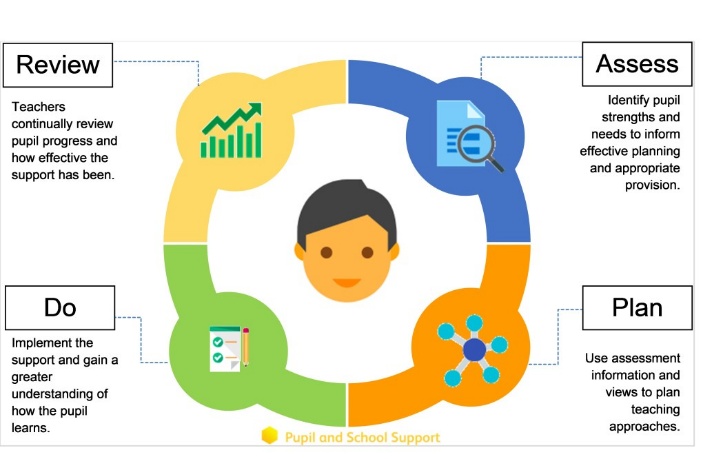
Teachers continually assess pupils' learning and progress as part of high-quality classroom practice. Where a pupil is making less progress than expected, staff consider possible barriers to learning and the additional support or adaptations that may be required.
If SEND concerns are identified, the child may initially be placed on the school's monitoring register and we will begin to follow the Graduated Approach: Assess, Plan, Do and Review.
During this period, appropriate adaptations, strategies or targeted support will be put in place and the impact of this support will be monitored.
After a period of approximately 6–8 weeks, progress will be reviewed. Where evidence indicates that a pupil has an identified special educational need requiring provision that is additional to or different from that normally available, the pupil may be added to the SEND register.
Parents and carers will be involved in this process and will have the opportunity to discuss the child's strengths, needs, targets and provision.
Some pupils may be assessed and monitored using the Birmingham Continuum Toolkits. These provide small step assessment frameworks and targets that can support pupils who are working below age related or key stage expectations and help staff identify appropriate next steps.
Where a pupil's needs are more complex, persistent or require expertise beyond that available within school, we may seek advice or assessment from appropriate external professionals.
Staff also use Birmingham's Ordinarily Available Guidance to support inclusive classroom practice and identify reasonable adaptations that can be made within the school environment.
The progress of pupils with SEND is monitored carefully. Teachers assess pupils' progress as part of normal classroom assessment, while progress towards individual SEND outcomes and targets is reviewed through the Assess, Plan, Do, Review cycle.

Depending upon the individual pupil, this may include consideration of:
- academic progress and attainment;
- progress towards individual SEND targets and outcomes;
- communication and interaction;
- independence and engagement with learning;
- emotional regulation and wellbeing;
- behaviour and attendance;
- social development and relationships;
- pupil and parent views; and
- the impact of interventions and additional provision.
Where provision is not having the intended impact, support may be adapted, increased or changed. Advice from external professionals may also be sought where appropriate.

Our approach to teaching children with SEND
We are an inclusive school where, wherever possible, pupils with SEND are taught alongside their peers within their classroom and flexible teaching groups.
High-quality teaching is the first response to pupils with SEND.
Teachers provide high-quality adaptive teaching to meet the needs of all pupils. This means adapting teaching, resources, communication, scaffolding and the learning environment while maintaining high expectations for every child.
Where necessary, individual arrangements or timetables may be developed to support a pupil's learning, regulation, wellbeing or access to education.
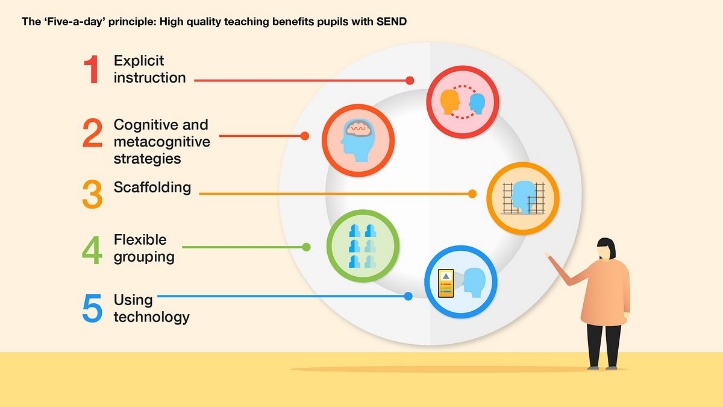
Staff may also deliver targeted interventions in small groups or provide individual support where this is appropriate to the pupil's identified needs.
We use the Education Endowment Foundation (EEF) Five-a-Day approach and embed its key principles throughout teaching and learning. Staff also use the Local Authority's Ordinarily Available Guidance to further strengthen inclusive classroom practice.
For some pupils with more complex needs, we offer an enhanced learning provision called The Hub. The Hub supports pupils who are unable to consistently access learning alongside their peers and who require ongoing specialist support, high levels of adult assistance and increased staff-to-pupil ratios. Pupils accessing The Hub will typically have an Education, Health and Care Plan (EHCP) or SEND Support Provision Plan (SSPP) in place. Provision is personalised according to individual need, with the aim of supporting pupils to access learning successfully, develop communication and independence, regulate their emotions and behaviour and participate in the wider life of the school wherever possible.

Curriculum adaptations
Our curriculum is adapted to ensure that pupils with SEND can access learning and experience success.
Teachers use adaptive teaching strategies such as breaking learning into smaller steps, providing visual supports, using practical resources, adapting tasks and outcomes, explicitly teaching key knowledge and vocabulary and providing additional processing time.
Strategies may include:
|
|
|
|
|
|
|
Visual timetables |
Task boards |
Assistive technology |
Talk partners |
Word banks |
|
|
|
|
|
|
|
Ear defenders |
Positive behaviour systems |
Explicit instruction |
timers |
Peer marking |
|
|
|
|
|
|
|
Self-assessment |
Regulations tools |
Flexible seating |
Multi modal communication |
Check ins |


Evaluating the Effectiveness of SEND Provision
We regularly monitor and evaluate the effectiveness of our SEND provision to ensure that the support pupils receive is having a positive impact.
The SENDCo and senior leadership team monitor provision through a range of approaches, including:
- pupil progress information
- SEND reviews
- Individual Learning Plans and individual targets
- intervention assessments and monitoring
- classroom observations and learning walks
- discussions with teachers and support staff
- attendance and behaviour information
- pupil voice
- parent and carer feedback
- recommendations and assessments from external professionals
Targeted interventions are reviewed to establish whether pupils are making progress towards their identified outcomes.
Where provision is not achieving the intended impact, we consider what needs to change. This may involve adapting teaching strategies, changing or increasing support, identifying different interventions or seeking additional specialist advice.
The effectiveness of provision for pupils with EHCPs and SSPPs is additionally considered through formal review processes involving pupils, families and relevant professionals.
Parent and Carer Consultations
At Featherstone Primary School, we value the strong partnership we have with parents and carers and recognise the important role families play in supporting children with SEND.
We operate an open-door approach and Miss Beach is happy to meet with parents and carers to discuss questions, concerns or support needs. She is also available during parents' evenings to provide further guidance and support.
We offer parent sessions throughout the year, providing opportunities for families to gain information, meet other parents and carers, share experiences and access support in a welcoming environment. For children with an EHCP, SSPP or those requiring specialist support beyond what is ordinarily available, we hold additional review meetings throughout the year.
These meetings provide opportunities to:
- celebrate achievements
- review progress towards agreed outcomes
- discuss the effectiveness of current provision
- agree new targets
- consider changing needs
- agree appropriate next steps
A copy of relevant review documentation is shared with parents and carers following meetings.
Reviews are child-centred and focus upon each pupil's individual strengths, needs and aspirations. Progress is celebrated, however small, and families are involved in agreeing outcomes and provision wherever possible.
Parents and carers are also invited to complete questionnaires and provide feedback about SEND provision within the school.
Child Consultation and Pupil Voice
Pupils' views are highly valued and we believe that children should play an active role in decisions about their education and support.
Children are encouraged to share their thoughts, feelings, strengths, difficulties and aspirations and are helped to understand the support available to them.
Pupil voice is embedded within our SEND processes and everyday teaching practice. Depending upon their age and communication needs, pupils may:
- self-assess how they are doing
- contribute to their targets
- attend or contribute to review meetings
- identify what helps them learn
- discuss difficulties or barriers they experience
- provide feedback about interventions and support
-
review their own progress
Alternative communication approaches are used where necessary to ensure that pupils who have communication difficulties are also able to express their views.
|
|
|
|
|
Self-assess how they are doing |
Attend meetings and help decide the support needed. |
Feedback and Review progress/intervention |


Supporting Emotional, Mental and Social Development
We recognise that some pupils with SEND require additional support with emotional regulation, wellbeing, confidence, relationships and social interaction.
Support is personalised according to individual need and may include pastoral support, targeted interventions, social skills work, emotional literacy support, access to trusted adults, regulation strategies, structured social opportunities and advice from external professionals.
Staff work to understand the underlying needs that may contribute to a pupil's behaviour and to provide appropriate support while maintaining clear, consistent and appropriate expectations.
Pupils are encouraged to identify trusted adults they can approach if they are worried or experiencing difficulties.
Featherstone Primary School does not tolerate bullying, including bullying related to SEND or disability. Our behaviour and anti-bullying procedures apply to all pupils. Additional support and reasonable adjustments are made where a pupil's SEND affects their vulnerability, social understanding, communication or ability to report concerns.

Staff Training
At Featherstone Primary School, we are committed to ongoing professional development and strive to ensure that staff have the knowledge and skills required to support pupils effectively.
When new staff join the school, they are supported to understand our SEND systems and procedures and are provided with relevant information about the pupils they will be working with.
The senior leadership team regularly reviews the needs of pupils across the school. Where particular areas of need are identified, whole-school or targeted training may be organised to further develop staff knowledge and practice.
Many members of staff have undertaken additional training in areas including:
|
|
|
|
|
|
Intensive Interaction |
Lego Therapy |
Trauma Informed Training |
Attention Autism |
|
|
|
|
|
|
Making Sense of Autism |
Makaton – Level 1 and 2 |
Precision teaching |
Positive Handling |
|
|
|
|
|
|
Developmental Language Disorder |
Understanding ADHD |
Aided Language Displays |
Colourful Semantics |







Where staff attend external training, they are encouraged to share their learning and strategies with colleagues so that expertise is developed across the school.

Specialist Support
Where a pupil requires expertise beyond that ordinarily available within school, we work with external professionals and specialist services.
These may include:
- Language and Learning Support Service
- Communication and Autism Team
- Birmingham Educational Psychology Service
- School Health Advisory Service
- Speech and Language Therapy
- Vision and Hearing Impairment services
- Sensory and Physical Support Service
- Behaviour Support
- Occupational Therapy
- other health, education or social care professionals as appropriate
We also commission additional specialist support where appropriate to meet identified pupil needs.
We value our multi-agency relationships, which enable us to provide coordinated support for pupils. Miss Beach regularly attends multi-agency planning meetings to discuss individual pupils, share concerns and identify emerging needs.
Parental consent is sought before external professionals become involved with a pupil where consent is required.
Following assessments or professional input, recommendations are discussed with families and incorporated into the pupil's provision where appropriate.

Equipment and Facilities
Where a pupil requires specialist equipment, resources or environmental adaptations, the school works with families and appropriate professionals to identify what is required.
This may include advice from Occupational Therapy, Sensory and Physical Support Services, Speech and Language Therapy, Communication and Autism services, or hearing and vision specialists.
Reasonable adjustments and specialist resources are provided according to individual need and professional advice, within the resources reasonably available to the school.

Transition Support
Nursery to Reception
We hold a parent and carer session during the summer term for new Reception starters, providing families with an opportunity to meet the class teacher and SENDCo.
This is followed by two taster sessions during the second half of the summer term.
Where children have identified SEND, enhanced transition arrangements may be provided. These can include additional visits, meetings with parents and professionals and opportunities to become familiar with staff and the environment.
Miss Beach attends enhanced transition meetings for pupils with an EHCP or SSPP.
End-of-Year Transition
When pupils move into a new year group, we provide transition information which may include photographs of their new teacher, teaching assistant and classroom environment.
Pupils have transition sessions during the summer term and some children are offered additional visits where this would support confidence, regulation or reduce anxiety.
Teachers and teaching assistants meet to share relevant information, including Individual Learning Plans, pupil needs and successful support strategies.
Secondary Transition
We work closely with secondary schools to ensure that transition from primary to secondary education is carefully planned.
For pupils with an EHCP or SSPP, Miss Beach leads enhanced transition arrangements involving secondary school staff, parents and carers, the pupil and relevant professionals.
Additional visits or transition activities may be arranged according to individual need.
Mid-Year New Starters
Where pupils with identified SEND join Featherstone Primary School during the academic year, we arrange to meet families as soon as possible to gather relevant information and ensure appropriate provision is established.
Where possible, we also liaise with the pupil's previous school or setting.

Looked-After and Previously Looked-After Children with SEND
At Featherstone Primary School, the SENDCo also holds the roles of Designated Teacher for Looked-After and Previously Looked-After Children and Designated Safeguarding Lead (DSL). This provides a coordinated approach to supporting pupils who are looked after or previously looked after and who also have special educational needs or disabilities.
Where applicable, SEND provision is considered alongside the pupil's Personal Education Plan (PEP), Education, Health and Care Plan (EHCP), Individual Learning Plan or other relevant support plan, ensuring that their educational, SEND, pastoral and safeguarding needs are considered together.
The school works collaboratively with carers, parents where appropriate, social workers, Virtual Schools, the Local Authority and other professionals involved with the child. Regular communication and multi-agency working help to ensure that provision is well coordinated, progress is carefully monitored and any emerging needs or concerns are identified and responded to promptly.
The views of the child are central to this process, and we aim to ensure that looked-after and previously looked-after pupils with SEND receive consistent, individualised support that promotes their progress, wellbeing, inclusion and educational outcomes.

Accessibility and Support for Disabled Pupils
Featherstone Primary School is committed to ensuring that disabled pupils are not treated less favourably than other pupils and that reasonable adjustments are made to enable pupils with disabilities to access education and participate fully in school life.
Admission arrangements for disabled pupils are administered in accordance with the school's published admission arrangements. Pupils will not be discriminated against in relation to admission because of a disability.
Where required, reasonable adjustments are made to:
- the physical environment
- curriculum and teaching
- communication and information
- resources and equipment
- school routines
- educational visits
- extra-curricular activities
- wider school events
Where specialist equipment, facilities or physical adaptations are required, the school seeks advice from families and relevant professionals.
Further information is available within the school's Accessibility Plan, which outlines how we aim to increase access to the curriculum, physical environment and information for disabled pupils.

Clubs and Trips
Our extra-curricular activities and school visits are open and accessible to pupils with SEND.
All pupils are actively encouraged to participate in educational visits and enrichment opportunities, including sports day, competitions, assemblies, performances and workshops.
Reasonable adjustments are made where required to enable pupils with SEND or disabilities to participate safely and meaningfully.
We also encourage children with SEND to apply for roles of responsibility within school, including Global Ambassadors, Values Ambassadors and Inclusion Ambassadors through our Job Shop process.
No child will be excluded from an opportunity simply because they have SEND or a disability.

Complaint Procedure
We are committed to working closely with parents and carers and aim to resolve concerns collaboratively and at the earliest opportunity.
If a parent or carer has a concern about the SEND provision being made for their child, their first point of contact will usually be the child's class teacher or the SENDCo.
If the concern has not been resolved, parents and carers may request an appointment with a member of the senior leadership team, such as an Assistant Headteacher or Deputy Headteacher.
If further discussion is required, an appointment may then be made with the Headteacher.
Parents and carers should refer to the school's Complaints Policy, available on the school website, for details of the formal complaints procedure.

Birmingham Local Offer and Support for Families
Birmingham's Local Offer provides information about education, health, social care and other services available for children and young people with SEND and their families.
The Birmingham Local Offer can be accessed at:
https://www.localofferbirmingham.co.uk/home/parents-and-carers/
Useful services include:
Special Educational Needs Assessment and Review Service (SENAR)
0121 303 0829
School Health Advisory Service
0121 465 5457
Forward Thinking Birmingham
0121 250 1560
Child Development Centre
0121 465 1582
Birmingham Children's Trust
0121 303 1888
Birmingham SENDIASS – Special Educational Needs and Disabilities Information, Advice and Support Service
0121 303 5004
SENDIASS provides impartial information, advice and support to children and young people with SEND and their parents and carers.

Feedback
We value feedback from our pupils and families and use this to help us review and further develop our SEND provision.
“We are pleased with how our child has settled into Y3 and the support put in place for her.”
“Since receiving SEND support, my child has made good progress.”
“I get a response very quickly when I ask. Overall I'm happy with SEN support and it's good to see the school keeping improving and offering various things for SEN children.”
Review of this SEN Information Report
This SEN Information Report is reviewed annually and updated during the year when significant changes to the school's SEND provision occur.
Academic Year: 2026–2027
SENDCo: Miss Helen Beach
Next Review: September 2027